ESEE · fixed blade knife (neck knife)
ESEE Izula-II
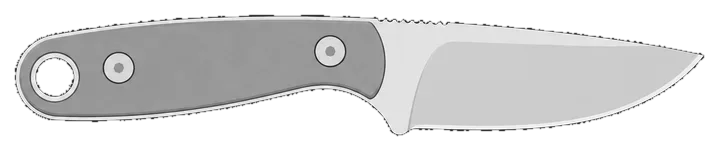
Fixed-blade knife, 2.63 in (67 mm) 1095 carbon-steel blade, 6.75 in overall, 3.2 oz (91 g) without sheath.
Where you are
Where to find it
Plain search links to Amazon. We earn nothing from them yet. Check the specification and your local law before you order.
Place by place
- No restriction found13
- Unclear6
- Reason needed24
- Restricted6
The maker does not publish the cutting edge, so length rules use the full blade as the worst case. That is why some places read unclear.
United Kingdom and Ireland
Fixed blades are never within the folding-pocketknife exemption. Carrying one in public needs a good reason or lawful authority (work, religion, national costume are listed examples).
Show full reason
Fixed blades are never within the exemption. Carrying one in public needs a good reason (work, religion, national costume are listed).
s9 has no folding-knife, length or lock exemption: any knife or article with a blade or sharp point carried in public is an offence unless you prove good reason, lawful authority, work use or a recreational purpose. Burden is on you.
Show full reason
Fixed blades are never within the folding-pocketknife exclusion. You must show a reasonable excuse or lawful authority (work, religion, national costume are listed defences).
Show full reason
Europe
Hunting and utility knives are not weapons (BMI); no blade-length limit. Zones and event orders can still apply, and a knife styled as a combat knife can be classed as a weapon.
Show full reason
Fixed blades, including daggers, are freely available weapons and not banned. The circular names daggers as freely available bladed weapons, and art. 9 makes carrying one in public depend on a legitimate reason you can show, such as hunting, fishing or work. Throwing knives and disguised blades are banned.
Show full reason
No blade length, lock or folder rule found, so a missing published length changes nothing. Carrying a knife in public is fined only when the manner or circumstances show intent to attack or injure. Do not show it or carry it so as to alarm people (art. 29(5)).
Show full reason
No national offence for carrying a knife in public was found. The Police Presidium (Policejní prezidium) spokesman says legislation does not limit carrying knives in public spaces. Premises owners and carriers set their own rules.
Show full reason
A fixed blade up to 12 cm is allowed in public only with a recognised purpose, such as work, hunting, fishing or outdoor use. Carry it packed away and go straight to the activity. A knife hung to be drawn from the neck needs a permit.
Show full reason
Järjestyslaki § 10 bans having a bladed weapon or similar object in a public place unless carrying it is needed for work or there is another acceptable reason. There is no blade length, lock or opening threshold. The police describe a folding knife or puukko without an acceptable reason as an offence. The government proposal names multitools as an example of a bladed weapon. Self defence is not accepted, and each case is judged on its facts.
Show full reason
Any other knife, including Opinel, Laguiole and Swiss-style knives: the government calls them category D (June 2025) or weapons 'by destination' (Feb 2025). Carrying needs a legitimate reason judged case by case; self-defence is not one.
Show full reason
Single-edged fixed blade of 12 cm or less is not covered by § 42a. Event, rail and local ban-zone rules still apply. Knuckle-handled (Faustmesser) fixed knives are banned outright and are not covered by this rule.
Show full reason
Any knife, of any length, is treated as a weapon. Carrying one is allowed only at 17 or over, if you can prove its purpose, and only on the way to or from that activity, packed away. Carrying it on you with no activity in view is not clearly covered.
Show full reason
Smaller or non-locking, two-hand knives (up to 8 cm, or folders under 5 cm) can still be 'strumenti atti ad offendere' (art. 4 comma 2): carrying without a justified reason is an offence of 1-3 years' arrest plus a €1,000-10,000 fine.
Show full reason
Single-edge fixed blades are not listed, but category IV-7 covers objects reasonably meant to injure given their nature or circumstances, and many councils ban carrying knives. No official text clears fixed blades; avoid carrying openly.
Show full reason
Straffeloven § 189 bars carrying any knife or similar sharp tool in a public place, with no blade length, lock or opening threshold. It does not apply when the knife is used or carried for work, outdoor life or another acceptable purpose (aktverdig formål). Self defence is not normally accepted. Blades of 25 cm or more also need such a purpose just to own.
Show full reason
Police state that having a knife in a pocket or on a belt is not an offence under art. 50a. It becomes one if circumstances indicate intent to commit a crime, for example brandishing it. Mass events, schools and private venues have separate rules.
Show full reason
A blade of 10 cm or less is not an arma branca by definition, so the class A and justification tests do not reach an ordinary single edge knife. Courts have held a short knife has a defined use.
Show full reason
A fixed-blade knife may be argued to be a cold weapon. The statute names daggers and bayonets but sets no blade length. The exceptions (hunting, fishing, sport, job) may apply but depend on the situation.
Show full reason
Fixed-blade knives are not 'navajas', so the 11 cm navaja ban does not apply, but art. 146 still bars carrying them outside home, work or sport unless there is a real need that agents accept.
Show full reason
Holding a fixed blade in public is banned unless justified by the activity, such as work, fishing, hunting or a grilling trip. Polisen says larger survival knives are not covered by a picnic. Crowds and events rarely justify it.
Show full reason
Not a 'weapon' if asymmetrical, 5 cm or less, or 30 cm or more. But the pocket-knife exemption does not cover it, so Art. 28a applies: carrying without a plausible use while seeming to intend misuse is banned; seizure possible.
Show full reason
North America
A fixed blade capable of stabbing is a dirk or dagger: criminal if concealed (e.g. under clothing). Carried openly in a visible sheath it is outside 21310. Banned at schools if blade over 2.5 in.
Show full reason
No federal blade-length limit or listing found for these. It can still become a 'weapon' offence if carried concealed (s.90) or for a dangerous purpose (s.88); push-dagger shapes and blades hidden in other objects are separately prohibited.
Show full reason
Fixed blades are 'weapons'. Eligible adults 21+ may carry concealed without a licence; no statute bars open carry of knives. Under-21 concealed carry is unsettled; school property is banned.
Show full reason
No specific restriction found. Georgia defines a knife for its carry offence as a blade greater than 12 inches, so a shorter blade is not a weapon under that section, whatever its lock or opening. This holds for switchblades too, because we found no state ban. School safety zones and some other places are stricter.
Show full reason
No statewide length limit. In Chicago, 8-24-020(f) bans carrying concealed any knife with a blade over 2.5 in (63.5 mm), so there it may only be carried openly. Other home rule towns may have their own rules. At a public gathering held under a government licence or in a place licensed to sell alcohol, 24-1(a)(8) makes carrying any other deadly weapon a felony; whether an ordinary knife counts there is not settled.
Show full reason
Fixed blades are not listed as such, but stilettos, daggers and dirks are, defined by design for stabbing. Courts decide case by case, so a single-edged utility fixed blade is likely fine but not certain.
Show full reason
A single edged fixed blade is not named in MCL 750.227. Whether it counts as a dagger or dirk, as a hunting knife adapted and carried as such, or as an other dangerous weapon depends on its design and why it is carried. That decides concealed carry (a neck knife or a belt knife under a coat) and carry in a vehicle. Carried openly on foot, only unlawful intent (MCL 750.226) and school property apply.
Show full reason
Not named, but a fixed blade can be a 'weapon' under 2C:39-1 ('other dangerous knives'). Carry is an offence under 2C:39-5(d) if circumstances are not manifestly appropriate (e.g. hunting, fishing, work). Concealed urban carry is risky.
Show full reason
Under 4 in blades: must be fully out of view. A pocket clip, hinge or top showing counts as open view per NYPD. Fixed blades worn outside clothing are barred.
Show full reason
No statewide length or carry ban found. Daggers, dirks and dangerous knives are an offence if possessed with intent to use unlawfully; possession itself is presumptive evidence of that intent (265.15(4)).
Show full reason
No specific restriction found. There is no length rule, and 2923.12(H) excludes any knife not used as a weapon from the concealed carry offence, including a double edged fixed blade. Use as a weapon, a school safety zone (R.C. 2923.122) and a courthouse (R.C. 2923.123) are the exceptions, because those sections use the deadly weapon test without the 2923.12(H) exclusion.
Show full reason
Since Act 119 of 2022 the offensive weapons definition no longer lists knives, so no statewide opening type ban. Carrying with intent to use criminally (s.907) and brandishing remain offences. School and court facility rules still apply. Philadelphia Code 10-820 still bans cutting weapons on public property, but 2023 federal court orders bar the City from enforcing it.
Show full reason
No specific restriction found on open or concealed carry of fixed blades 5.5 in or shorter. Premises owners may still exclude you.
Federal law does not regulate carrying it in public; state and local law decide. Inside a federal building or federal court facility, any knife readily capable of causing death or serious injury is a dangerous weapon and banned there (up to 1 year; court facilities up to 2 years); the only exception is a pocket knife with a blade under 2.5 in. Courts may set stricter rules.
Show full reason
No state ban on carrying fixed blades, but Seattle 12A.14.080 B bans carrying any dangerous knife, open or concealed, and 12A.14.010 makes every fixed blade one whatever its length. Elsewhere in the state no restriction was found, though other cities may have their own rules. Statewide, furtively carrying a dagger or dirk with intent to conceal is an offence (9.41.250), and displaying a knife to alarm others is an offence (9.41.270). Seattle's defences (12A.14.100) cover hunting and fishing, work, and carrying it wrapped to or from home, a shop or a repair.
Show full reason
Dangerous by design or circumstances is a fact question. Fixed blades, especially daggers and double-edged ones, are likelier to be treated as weapons than pocket tools. Blades over 3 in matter under 22-4514(b) only with unlawful intent.
Show full reason
Australia and New Zealand
All six states and both territories make carrying a knife in public an offence without a lawful or reasonable excuse (work, sport, recreation and so on); self defence alone is never an excuse. Use the state entry for details.
Show full reason
Any other knife in a public place or school, including pocket knives, multitools, karambits and bowie knives, needs a reasonable excuse such as work, food, sport, recreation, a uniform or religion. Self defence alone is not one.
Show full reason
Any knife or blade in a public place or school, including pocket knives and multitools with a blade, is an offence unless you prove a reasonable excuse (work, food, sport, uniform, genuine religious purpose; self defence excluded). Burden is on you.
Show full reason
Any knife, including folders, fixed blades and multitools with a blade, in a public place needs a reasonable excuse (s.13A, s.202A). No blade-length exemption. Work, trade, fishing, camping or religious (kirpan) use can qualify; self-defence does not.
Show full reason
Any other knife, including pocket knives, multitools, daggers, karambits and bowie knives, is a controlled weapon: in a public place or school you need a lawful excuse such as work, sport, recreation or a collection. Self defence is not one.
Show full reason
Any knife you physically possess in a public place (includes places visible from a public place) or school needs a reasonable excuse: lawful activity/employment, sport, exhibiting, or lawful purpose (e.g. pen knife or Swiss Army knife for normal utility). Self defence is excluded.
Show full reason
Any other knife in a public place, education facility or place of worship needs a lawful excuse (s.21E; 6 months, or 12 months for repeat). A visibly carried offensive weapon that scares someone is a separate 2 year offence.
Show full reason
Any knife in a public place, from a pocket knife, multitool or credit card tool to a karambit or bowie, needs a lawful excuse: work, sport or recreation, a collection, its intended lawful use, or religious observance. Self defence never counts; you must prove the excuse.
Show full reason
Other knives (folders, fixed blades, multitools with a blade) are controlled weapons: need a lawful excuse (employment, lawful sport/recreation, collection). Courts consider time and place. Self defence is excluded. Daggers, throwing blades and machetes are prohibited.
Show full reason
A knife (or blade, axe, machete) anywhere in WA needs a lawful excuse: lawful work/duty/activity, sport/recreation/entertainment, or collection/display. Self defence is excluded and you must prove the excuse. Round tipped dull and plastic/wooden eating knives are excluded. Even with excuse, carrying that scares people is an offence.
Show full reason
Asia
Carrying a blade over 6 cm needs work or another justifiable reason; self defence is not one. The one carve out is a non locking folder of 8 cm or less within set width and thickness. A blade of 6 cm or less is outside Art. 22, but carrying any blade hidden, such as in a pocket or bag, without a justifiable reason breaches the Minor Offences Act. Butterfly knives count here like any folder.
Show full reason
“No specific restriction found” is not a promise that you may carry it. Transport rules, local bans, events, schools and how you behave all still apply. How we check.
Flying with it
A knife with a blade does not go through the security checkpoint in most places. It travels in checked baggage, if the airline allows it.
- United States (TSA/FAA): not allowed in the cabin. Source
- European Union (Reg. (EU) 2015/1998 Att. 4-C, national/airport variations): allowed in the cabin with conditions. Source
- United Kingdom: not allowed in the cabin. Source
- Canada (CATSA): allowed in the cabin with conditions. Source
- Australia (Home Affairs / CASA): not allowed in the cabin. Source
The security officer has the final say. See the full flying guide.
Giving it or taking it to a Christmas market
- Giving it to a child or teenager: age rules for a 12, 14 or 16 year old, place by place.
- Giving it to someone in another place: check the law where they live, or see what couriers and customs allow.
- Knives at Christmas markets: the rules in 19 places.
- Giving it to someone who flies: what clears airport security.